That first proper chord through an amp is the moment many players get hooked. It is also why the best beginner electric guitar bundle is not simply the cheapest box with a guitar-shaped object inside. A good starter package should feel comfortable in your hands, stay in tune, make a sound you want to hear and include enough useful kit to get you playing on day one.
For a first-time player, buying a bundle can be a brilliant route into electric guitar. It removes the guesswork around leads, amplification and the small essentials that are easy to overlook. The key is knowing where a bundle offers real value and where it has cut corners that will make learning harder.
What makes the best beginner electric guitar bundle?
Start with the guitar itself. The badge on the headstock matters less than basic build quality, playability and whether the instrument suits the music you want to make. A beginner should be able to fret clean notes without fighting high strings, turn the tuners smoothly and use the controls without crackles or loose parts.
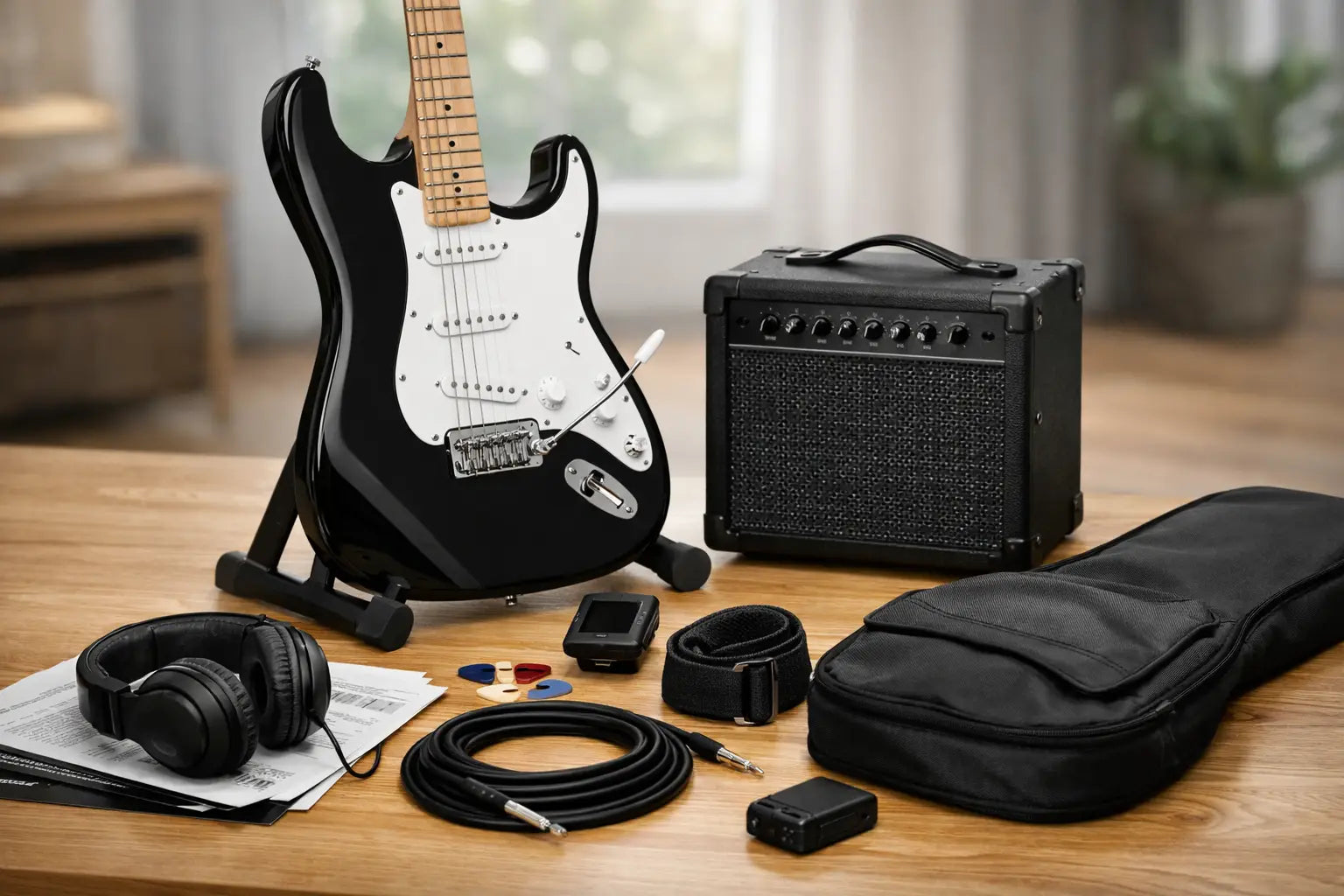
A sensible package pairs a playable guitar with a small practice amp, a lead, strap, picks and a way of keeping the guitar in tune. Some include a gig bag and spare strings too. Those are useful additions, but do not let an overstuffed accessory list distract from the guitar and amp. A dozen low-cost extras do not compensate for an instrument that will not hold tuning.
The right bundle also depends on where you will play. A compact amp with a headphone output is a genuine advantage if you are learning in a bedroom, flat or busy family home. If you are hoping to rehearse with friends before long, a slightly more powerful amp with a clean sound and a usable gain channel will give you more room to grow.
Choose the guitar shape for the music you enjoy
There is no rule saying a beginner must start with one particular style. The best choice is usually the guitar that makes you want to pick it up again tomorrow.
Strat-style guitars: flexible and familiar
Strat-style electric guitars are popular in beginner bundles for good reason. Their contoured bodies sit comfortably against you, the double cutaway gives easy access to higher frets and three pickups can cover bright clean sounds, bluesy edge and classic rock tones. They are a particularly safe all-round choice for someone still working out their musical direction.
Many use a vibrato bridge with an arm. This can be great fun, but it adds a little more complexity when changing strings or making adjustments. It is not a problem if the guitar is properly set up, though a fixed-bridge model is often the simplest option for a complete beginner who wants maximum tuning stability.
Tele-style guitars: straightforward and characterful
Tele-style models tend to have a simpler fixed bridge and two pickups. They are renowned for a direct, punchy sound that works beautifully for indie, country, blues, punk and rock. Their slab-style body is less sculpted than a Strat-style guitar, so it is worth sitting down with one if possible. Some players love that solid, no-nonsense feel immediately.
Double-cut and humbucker guitars: made for thicker sounds
If your playlist leans towards hard rock, metal, pop-punk or heavier blues, look for a guitar with humbucker pickups. Humbuckers generally produce a fuller, more powerful sound and reduce the background hum associated with single-coil pickups. A double-cut design can be light, comfortable and easy to play, while a tune-o-matic style fixed bridge keeps the practical side refreshingly simple.
Do not assume humbuckers are only for heavy music. Turn the volume down a touch, select the neck pickup and they can sound warm and smooth for cleaner playing too.
The amp matters more than most beginners expect
An electric guitar without an amp is only half the experience. Tiny practice amps included in bundles vary enormously. Some are perfectly capable for learning riffs and practising chords; others are thin, harsh and quickly become frustrating.
Look for a proper volume control, a gain control for driven sounds, basic EQ and a headphone output. An auxiliary input or Bluetooth function can be useful for playing along with lessons and backing tracks, but sound quality should come first. A clean tone that remains clear at sensible home volume is often more valuable than a long list of effects.
Modelling practice amps can be excellent for beginners because they offer several amp voices and effects in one compact unit. They are ideal for trying clean, crunch and high-gain sounds without buying pedals straight away. The trade-off is that extra controls can distract from the basics. If twisting knobs becomes more appealing than practising chord changes, a simple two-channel amp may serve you better.
Wattage is not the whole story. A 10 to 20-watt solid-state practice amp is generally plenty loud for home use. More watts do not necessarily mean better tone at low volume, and a small amp that sounds good quietly is likely to get used far more often.
Do not overlook setup and comfort
A guitar can be well made and still feel difficult if it has not been checked and adjusted. The action - the gap between strings and frets - needs to be low enough for comfortable playing but not so low that notes buzz excessively. The neck should be sensibly straight, the intonation should be close and the nut slots should allow the strings to move freely.
This is where buying from a specialist guitar retailer can make a real difference. A guitar that has been inspected, tuned and given a basic playing check arrives ready for the exciting part. At Chordplay Guitars, workshop experience also means there is practical help available when your needs change, whether that is a first restring, a setup after a few months of playing or advice on an upgrade.
Physical comfort deserves the same attention. Younger players and anyone with a smaller frame may prefer a lighter body or a short-scale instrument. Full-scale guitars suit plenty of children and teenagers, but there is no prize for choosing an instrument that feels oversized. Sit with it, stand with a strap on and see whether your fretting hand can reach the first-position chords without straining.
What should a beginner bundle include?
The essentials are modest: an electric guitar, a practice amp, a jack lead, strap, picks and a tuner. A padded gig bag is useful if the guitar will travel to school, lessons or a mate's house. A clip-on tuner is quick and easy, while a phone tuning app can work well at home, provided the room is quiet.
A few items are worth adding if they are not in the box. A guitar stand keeps the instrument visible and within reach, which quietly encourages practice. A spare set of strings prevents a snapped high E from ending a productive week. A simple capo is handy later on, though it is not a day-one necessity.
Be wary of packages that include a very thin, unpadded bag, a poor-quality cable and a tuner that is difficult to read. They are not deal-breakers if the guitar and amp are strong, but replacing them soon adds to the real cost. It can be better value to buy a dependable guitar-and-amp pairing, then choose the smaller accessories separately.
New bundle or quality used guitar?
A new bundle is convenient, covered by the retailer and usually contains everything needed to begin. It is especially appealing when you want one clear purchase for a birthday, Christmas or a first lesson. Mainstream starter ranges from established makers can offer excellent value, with designs that have helped generations of players get going.
A quality used guitar is another route worth considering. For the same budget, a carefully checked pre-owned model can sometimes offer better components, a more substantial feel or a guitar that will remain satisfying for longer. It will not always come with every accessory, so allow for an amp, lead and tuner if required.
Condition is the deciding factor. Cosmetic marks are often harmless and can even make a first guitar less precious to use. Neck issues, unstable tuning, worn frets or faulty electronics are different matters. Buying used through a trusted specialist, rather than taking a chance on an untested private sale, gives a beginner far more confidence.
Set a budget that leaves room to enjoy playing
At the entry level, the temptation is to spend as little as possible in case the hobby does not stick. That is understandable, but an awkward guitar is far more likely to put someone off than a sensible step up in budget. Aim for the point where the guitar plays properly, the amp has a usable sound and the essentials are not an afterthought.
There is no need to buy pedals, a huge amplifier or a collector-grade instrument at the start. Learn to tune, make clean chord changes, keep time and use the guitar's volume and pickup controls. Those skills will make any future upgrade more rewarding because you will know what you actually want from it.
If you can visit a showroom, try a few body shapes and ask staff to play the same short phrase through each amp at a comfortable volume. You do not need to perform or know any songs. Notice which guitar feels balanced, which neck feels natural and which sound makes you smile. That small reaction is usually more useful than a specification sheet.
A first guitar does not have to be forever, but it should be good enough to make the next practice session feel like a treat rather than a chore. Choose the bundle that gives you a reliable start, then let your own playing point the way to whatever comes next.
Share:
Where to Sell Your Guitar for Cash in the UK