A child can be completely taken with the idea of playing guitar, then lose heart after five minutes with an instrument that feels like a wardrobe in their lap. That is why the question of which guitar size suits children matters more than simply buying the smallest guitar on the shelf. The right size should feel comfortable enough to hold, easy enough to fret, and good enough to make them want another go tomorrow.
A smaller guitar is not automatically the best choice, either. Children grow quickly, hands vary hugely, and a poor-quality mini instrument can be harder to tune and play than a properly set-up full-size guitar. The aim is a guitar that meets the child where they are now without holding back their next stage of learning.
Which guitar size suits children by age and height?
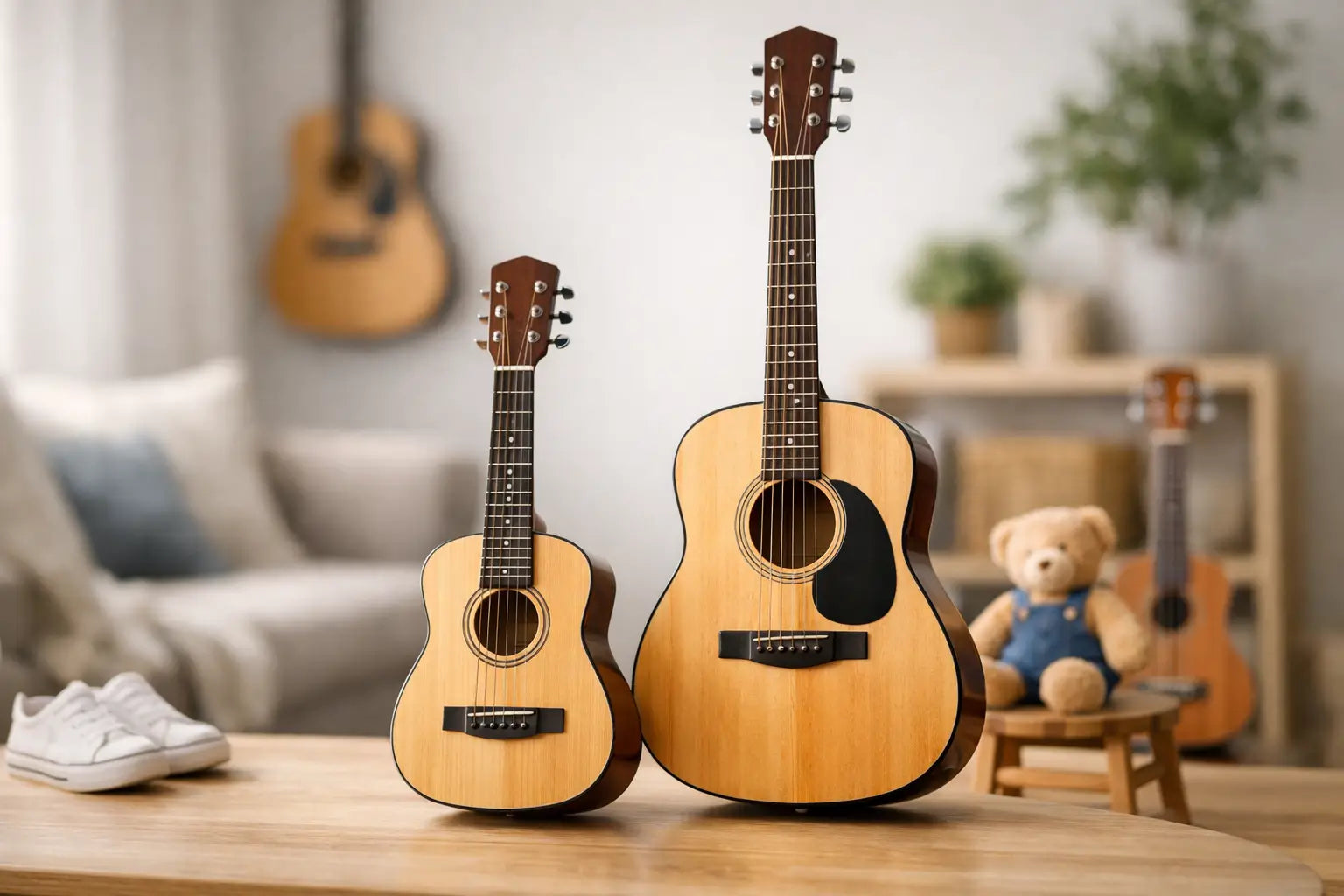
Guitar sizes are usually described as fractions of a standard full-size instrument. These are useful starting points, not hard rules. A confident eight-year-old with long arms may be comfortable on a larger guitar than a smaller ten-year-old, while a child already playing another instrument may adapt more quickly.
| Typical player age | Usual guitar size | Approximate scale length | Best suited to |
|---|---:|---:|---|
| 3 to 5 | 1/4 size | 17 to 19 inches | Very young beginners and small frames |
| 5 to 8 | 1/2 size | 19 to 22 inches | Most early primary-school learners |
| 8 to 11 | 3/4 size | 22 to 24 inches | Growing players who need more room |
| 11+ | 7/8 or full size | 24 to 25.5 inches | Taller children, teens and long-term learners |
These bands overlap for a reason. Height and reach are generally more helpful than age alone. When seated, the child should be able to rest the guitar on their leg without lifting their shoulder or stretching their fretting arm straight. Their fretting hand should reach the first few frets with a relaxed bend in the elbow, and the picking arm should sit over the body without hunching.
If they need to lean backwards to see around the guitar, the body is probably too large. If their hand feels cramped around the first-position chords, it may be too small - or simply have a neck that does not suit them.
Start with comfort, then consider the numbers
The scale length is the key measurement behind the fractions. It is the vibrating length of the strings, running from the nut to the bridge. A shorter scale reduces the distance between frets and usually lowers the string tension, both of which can make early chord shapes less demanding on small hands.
But scale length is only one part of the fit. Body depth, upper-bout shape, neck width, string gauge and the guitar's setup all affect how manageable it feels. A slim-bodied 3/4 acoustic can feel friendlier than a bulky 1/2-size model. A compact electric with a comfortable contoured body may be easier for some children to hold than a small classical guitar.
For this reason, avoid choosing solely from a product photo or an age label. If possible, let the child sit down with the instrument. Ask them to make a simple strumming motion and place one finger behind the first fret. They do not need to know a chord yet. You are looking for a natural posture rather than a polished performance.
Acoustic, classical or electric: the size question changes
Parents often begin by deciding between acoustic and electric, then look at size. In practice, it makes sense to consider both together because each type places different demands on a young player.
Classical guitars are often a gentle first step
A nylon-string classical guitar is a popular choice for younger beginners. Nylon strings are generally kinder on fingertips than steel strings, the wide neck gives fingers a little more separation, and 1/2 and 3/4-size classical models are widely available. They are particularly well suited to school tuition where a classical-style instrument is requested.
The trade-off is that the wider neck can feel substantial for a child with especially small hands. Classical bodies can also be deeper than expected. It is worth checking that the child can reach around the lower bout comfortably.
Steel-string acoustics offer the familiar singer-songwriter sound
A steel-string acoustic suits children who want to strum pop songs, accompany singing or follow the sound they hear from favourite artists. Look for a parlour, travel or junior body shape rather than a full dreadnought. A dreadnought can be a brilliant adult guitar, but it is often too broad and deep for a smaller player to control comfortably.
Steel strings need more finger pressure, particularly on an instrument with a high action. A good setup makes a massive difference here. Lowering an excessively high action, fitting sensible light-gauge strings and ensuring the guitar holds tune can turn a frustrating starter instrument into one a child actually enjoys.
Electric guitars are not only for older children
A short-scale electric guitar can be an excellent first instrument, especially for a child drawn to rock, indie, metal or blues. Its thinner body is easy to hold, the strings can be lighter, and an amplifier can make even basic notes sound exciting. That early reward matters.
An electric setup does involve a little more gear: a lead, a small practice amp or headphones solution, and somewhere safe to keep it. Yet it does not have to be loud. For many families, headphones make electric guitar practice one of the more neighbour-friendly musical options.
Do not buy a guitar they will outgrow in six months - unless it truly fits now
There is a temptation to buy a full-size guitar for a seven-year-old and hope they grow into it. Occasionally that works, particularly with a tall, determined child. More often, it puts the instrument physically in the way of learning. Early progress depends on repeating simple movements, and uncomfortable posture makes that work feel far harder than it should.
Conversely, buying the tiniest possible guitar for a child who is close to a 3/4 or full-size fit can create a different problem. They may outgrow it rapidly, and the short fret spacing can feel restrictive as their hands develop.
A sensible middle ground is to buy for the child you can see today, with a little room to grow. For many players between roughly eight and eleven, a decent 3/4 guitar is the sweet spot. It is large enough to feel like a proper instrument, portable enough for lessons, and capable of sounding genuinely musical for years.
Sound and tuning are part of the motivation
Size gets the headline, but quality is what keeps the first few months enjoyable. A guitar that will not stay in tune teaches a child that their ears are wrong. One with sharp fret ends or a painfully high action makes every chord feel like a test of strength.
This does not mean a first guitar must be expensive or collector-grade. It does mean it should be fundamentally sound, correctly adjusted and appropriate for the style they want to play. Used instruments can represent excellent value when they have been checked properly, while a well-chosen starter bundle can remove the guesswork around essentials.
At Chordplay Guitars, the advantage of trying an instrument in person is not just choice. It is the chance to compare body sizes, ask about string tension and get practical advice from people who know when a setup will make the real difference. For online buyers, do not be afraid to ask for specific measurements and an honest view of who a model suits.
A quick fitting check before you commit
When the child sits with the guitar, check four things: the lower bout rests securely on their leg; their shoulder remains relaxed; their fretting wrist is not sharply bent; and they can reach the first frets without twisting their torso. If all four are in place, the size is likely sensible.
Then let them choose between two comfortable options where possible. One child will love the warm, rounded feel of nylon strings; another will immediately light up when an electric guitar makes a big sound through a small amp. That reaction is useful information, not a distraction from the practicalities.
The best first guitar is not necessarily the one that looks most grown-up, costs the least or promises to last forever. It is the instrument that fits their hands, suits the music they are excited by, and makes the next practice feel like an invitation rather than a chore.
Share:
How to Sell Guitars Online Safely and Fairly
Beginner Guitar Brands Worth Your First £200