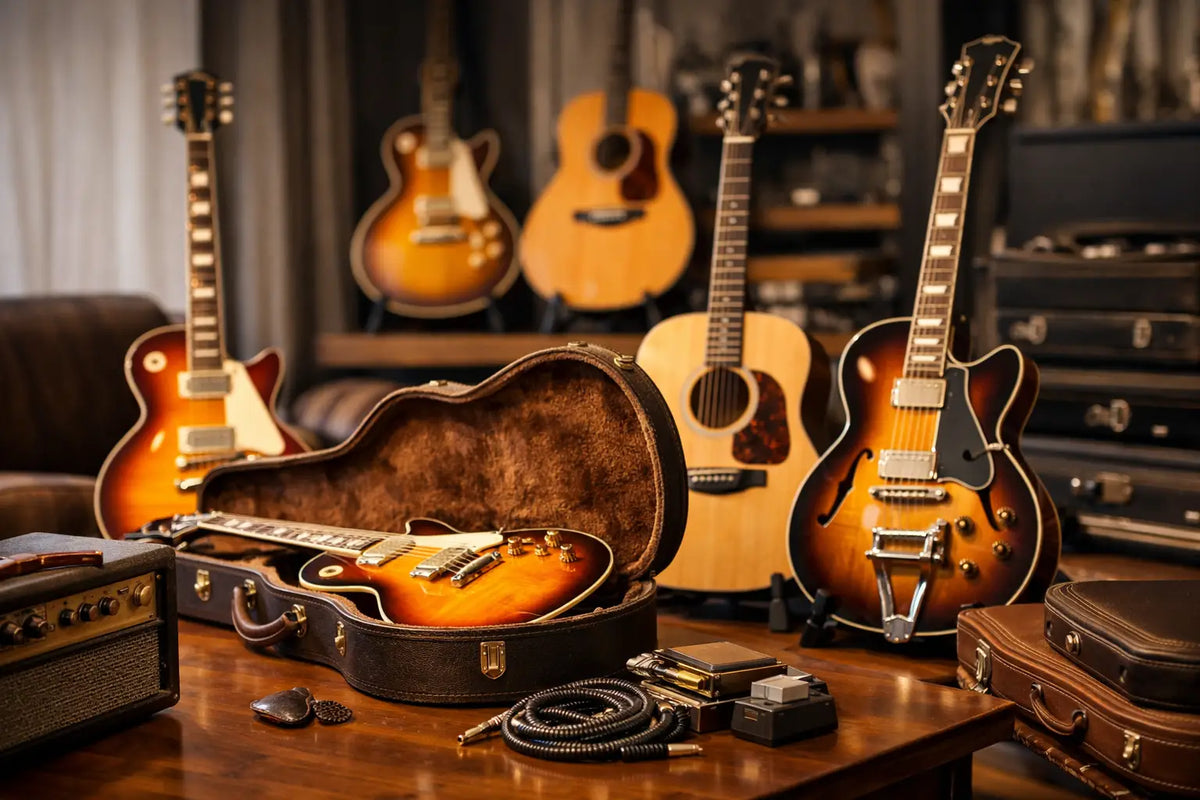
A great guitar collection rarely starts with a grand plan. More often, it begins with one instrument that feels different in the hands: an older Japanese-made solid body, a properly worn-in acoustic, a British-built oddity, or the guitar you always wanted after seeing it on a favourite record sleeve. Guitar collecting is about chasing those moments, but the best collections balance excitement with judgement.
Whether you have room for three guitars or thirty, the aim is not simply to fill stands. It is to build a group of instruments with character, useful differences and a story you genuinely enjoy being part of.
Start guitar collecting with a reason
The strongest collections have a point of view. That does not mean every guitar needs to be from the same brand, decade or country, but it helps to know what draws you in. You might be interested in vintage British electrics, 1970s Japanese copies, unusual offsets, classic American designs, artist-associated models or high-spec modern instruments that are simply brilliant to play.
A player’s collection may be built around sounds. One guitar covers bright single-coil rhythm work, another handles humbucker crunch, a semi-acoustic brings warmth, and an acoustic is ready for songwriting or gigs. A collector may care more about rarity, original finish, a particular factory or a short-lived specification. Most people sit somewhere between the two.
There is no wrong approach, but buying without a focus can lead to a room full of near-identical guitars and very little inspiration. Before the next purchase, ask what it adds that your current instruments do not. Sometimes the honest answer is that it adds nothing practical, but makes you grin every time you open the case. That counts too.
Learn to read condition properly
Condition has a huge influence on desirability, value and future repair costs. It is also more nuanced than a simple mint-or-used label. A 50-year-old guitar with honest playing wear can be more appealing than one that has been poorly refinished to look new.
Start with the structural essentials. Look for headstock repairs, cracks around the neck joint, movement at the bridge on acoustics, lifting braces and signs of damp or excessive dryness. Check that the truss rod works, the neck has a sensible amount of relief and there is enough fret life left for a good setup. Electronics should be tested, but scratchy pots or a tired selector are usually straightforward workshop jobs. Serious structural faults are another matter.
Originality matters most where collector value is concerned. Original pickups, finish, hardware, plastics and case can all affect the price. That said, originality is not always the whole story. A professional refret can make a vintage guitar far more usable, while a sympathetic replacement bridge or tuners may be sensible on an instrument intended for regular gigging. The key is clear disclosure and fair pricing.
Photographs tell part of the story, but they cannot replace holding an instrument. If you can visit a showroom, play it unplugged and amplified. Feel the neck profile, check its balance on a strap and listen for dead notes. If you are buying remotely, detailed images, an accurate condition description and knowledgeable answers are worth far more than vague claims of being "rare".
Provenance is part of the instrument
The best paperwork is not always glamorous, but it can be valuable. Original sales receipts, warranty cards, catalogues, case candy, service records and photographs all help establish what a guitar is and where it has been. For a limited run, a custom order or a genuinely unusual model, these details can make the difference between an interesting guitar and a properly documented collector piece.
Serial numbers should be treated as a useful starting point rather than final proof. Dating systems differ wildly between brands and periods, and parts may have been changed over time. Learn the details that identify the model you are looking at: logo style, neck construction, pot codes, pickup markings, finish options and hardware used in that production period.
This is especially worthwhile with Japanese-made instruments. There are exceptional guitars from the major factories, but model names, export variations and specifications can be confusing. A good example can offer superb build quality and a distinctive chapter of guitar history. A rushed purchase based solely on a headstock logo can be disappointing.
Buy the guitar, not the story
Every collector hears a tempting story eventually: it was owned by a famous player, only a handful were made, it came from a closed-down studio, it has never been played. Occasionally, the story is true. More often, it is impossible to verify or has grown with each previous owner.
Pay for what can be supported by condition, specification, documentation and the current market. A celebrity connection only deserves a premium when there is credible evidence. Equally, a low production number does not automatically make a guitar desirable. Rarity without demand is simply scarcity.
Set a realistic all-in budget before you buy. Include a hard case if one is needed, insurance, a professional setup and any immediate work identified during inspection. A guitar that looks cheaper than comparable examples may still be the right buy, but only if the required work has been priced honestly. There is nothing wrong with a project instrument. Just do not mistake one for a ready-to-play collector grade example.
Make space for great players
A collection should not become a museum by accident. Many instruments hold their value because they are excellent guitars, not because they remain untouched. Regular playing helps you understand what you own, gives each piece a purpose and makes it easier to spot a guitar that deserves to move on.
Keep a simple record for every instrument: make, model, year, serial number, purchase date, price, condition, modifications and any included documents. Take clear photographs when it arrives. This is useful for insurance, future resale and your own memory, especially once the collection grows beyond a few guitars.
A sensible rotation can keep things fresh. Take one guitar to rehearsal for a month, record with another, or leave an acoustic out where you will actually pick it up. The instrument that has been in its case for two years may still be special, but it is worth asking whether someone else would enjoy it more.
Storage and maintenance protect the collection
Guitars are made from wood, glue, metal and electronics. They need a stable environment, not a special shrine. Avoid lofts, garages, damp cellars, radiators and sunny windows. Sudden swings in temperature and humidity are harder on an instrument than a sensible, lived-in room.
Hard cases offer the best protection for valuable, vintage and acoustic guitars. Stands and wall hangers are excellent for daily players, provided they are secure and the finish is compatible with the hanger material. Some older nitrocellulose finishes can react with unsuitable rubber or foam, leaving marks that are difficult to remove.
Basic care goes a long way: wipe strings and hardware after playing, keep cases clean, change strings before they corrode into the fretboard, and do not overtighten a truss rod or bridge adjustment without knowing what you are doing. For fretwork, neck issues, crack repairs or vintage electronics, a proper workshop assessment is money well spent. At Chordplay Guitars, the in-house workshop can handle everything from a straightforward restring and setup to refrets, repairs and restoration work.
When to trade, sell or hold
Collections evolve. Tastes change, hands change, and the guitar you thought would be a keeper may stop earning its place. Trading can be an enjoyable way to sharpen a collection without constantly adding more instruments. A fair part-exchange also removes much of the uncertainty and time involved in private sales.
Holding on makes sense when a guitar is genuinely difficult to replace, has personal history or still inspires you. Selling makes sense when it funds something more meaningful, reduces duplication or lets a neglected instrument return to active use. Do not keep a guitar purely because you once paid too much for it. That decision has already been made; the next one should be about the guitar’s role from here.
The most satisfying collections feel personal rather than perfect. Learn the details, buy carefully, keep your instruments healthy and leave room for the occasional surprise. The guitar that becomes your favourite may not be the rarest one in the room. It may simply be the one you cannot put down.
Share:
Why Rising Japanese Guitar Values Matter Now
When Guitars Need Refretting and What to Do