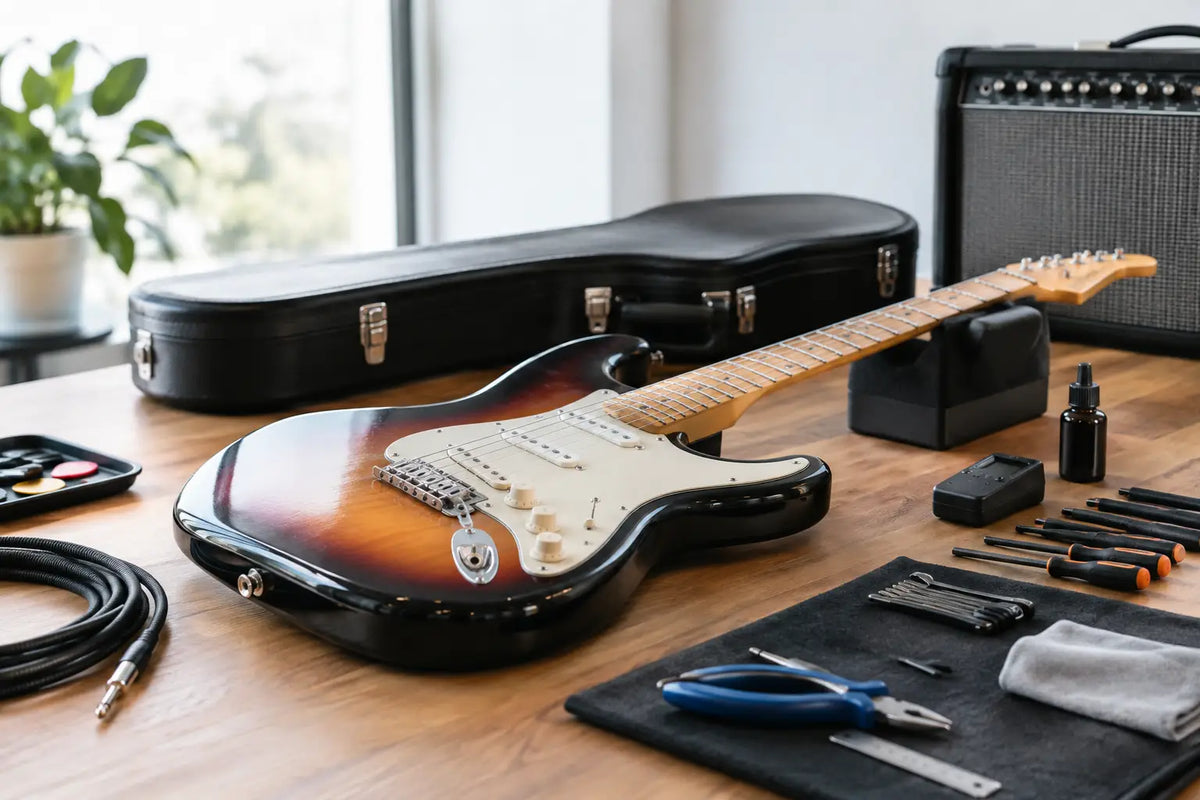
A guitar setup price is not simply the cost of making a few adjustments. It is the price of making your instrument feel like it belongs in your hands again - comfortable, in tune and ready to play properly. Whether you have picked up a first electric, brought home a rare Japanese classic or have a faithful gigging guitar that has started fighting back, a professional setup can make a remarkable difference.
The tricky bit is that no two guitars arrive on a bench in quite the same state. One may need a straightforward restring and action adjustment. Another may reveal worn frets, a loose nut, a twisted neck or electronics that crackle every time you touch the volume control. Understanding what is included helps you compare workshop quotes fairly and choose the right level of care.
What does a guitar setup price usually include?
A standard setup is a series of linked adjustments, not one magic screw-turn. The technician first checks the neck relief, then sets the string action at the bridge, checks nut height, makes sure the guitar intonates correctly and assesses the overall playability. The strings need to be in good condition, the hardware must be stable and the instrument needs time to settle between adjustments.
On an electric guitar, this often includes setting the bridge, tremolo or tailpiece, balancing pickup height and checking that the controls and output socket are behaving as they should. On an acoustic or classical guitar, the emphasis is usually on neck relief, saddle height, nut slots, string choice and comfortable action without unwanted buzz.
A good workshop will also look beyond the headline job. They may spot a lifting fret, a cracked saddle, a slipping machinehead or an early sign of structural movement. That inspection is part of the value. It is far better to know what your guitar needs than to keep adjusting around a fault that will not disappear on its own.
Typical guitar setup prices in the UK
For a basic professional setup, UK players will commonly see prices beginning around £50 to £90, with the exact figure depending on the instrument, its bridge system and whether strings are included. A simple fixed-bridge electric that is generally healthy is usually quicker to set up than a Floyd Rose-equipped guitar, a 12-string or an acoustic with high action.
Think of this as a starting point rather than a universal menu price. A workshop may charge separately for strings, replacement parts and any work discovered after the initial inspection. That is not automatically an upsell. It reflects the difference between adjustment work and repair work.
For example, a guitar with a well-cut nut may only need minor changes. If the nut slots are too high, too low or poorly shaped, correcting them properly takes specialist files, experience and patience. Likewise, a guitar that cannot intonate because its frets are heavily worn does not need a more determined setup. It needs fretwork before a setup will hold.
Why some guitars cost more to set up
Complex hardware adds time. Floating trems and locking systems need to be balanced against string tension, spring tension and the player’s preferred tuning. A change from regular tuning to drop C, or from .009s to heavier strings, can alter everything from neck relief to tremolo angle. A properly set-up guitar needs to be set up for the strings and tuning you will actually use.
Vintage instruments require another level of judgement. A 1960s acoustic, a valuable Gibson or an unusual MIJ model may have non-standard components, delicate finishes and decades of wear that deserve careful treatment. The goal is not to force a collector-grade guitar into modern factory specifications. It is to improve its playability while respecting its originality and character.
Bass guitars can take longer too, especially five- and six-string models. Their longer scale length, heavier strings and wider necks make accurate relief and intonation particularly important. A bass that feels only slightly stiff at home can become exhausting over a full rehearsal or set.
What a setup cannot fix
A professional setup is one of the best-value jobs you can have done, but it has limits. It cannot straighten a severely warped neck, repair a cracked headstock, replace missing fret height or resolve an acoustic guitar whose neck angle has changed substantially over time.
This matters when considering the cheapest quote. If a guitar has a genuine underlying issue, a quick adjustment may make it marginally better for a while, but it will not make the repair unnecessary. An honest technician should explain what can be achieved within a setup and what would require additional work, such as a fret level and crown, nut replacement, neck reset, structural repair or electronics service.
Ask for a clear explanation before authorising extra work. You should know what has been found, why it affects the guitar and whether it is essential now or sensible to monitor. There is a world of difference between a cosmetic blemish and a fault that will stop the instrument playing reliably.
Choosing the right setup for how you play
The best setup is personal. A jazz player who uses .012s and wants clean, controlled chords may prefer a different action from a blues player who digs in with .010s and bends aggressively. A beginner needs a guitar that feels welcoming, not a guitar set impossibly low for a light touch it has not yet developed.
Tell the workshop how you play before the work starts. Mention your usual tuning, preferred string gauge, whether you use a slide, how hard you pick and any particular problem areas. If the low E rattles only when you play hard, or the G string chokes on bends above the 12th fret, that information is genuinely useful.
It is also worth being realistic about buzz. Very low action and absolutely no fret noise do not always coexist, especially when a guitar is played with conviction. A skilled technician can find a sensible balance, but the right answer depends on your touch, your amp settings and whether the guitar is for home practice, recording or regular gigs.
Strings are part of the job, not an afterthought
Fresh strings make a setup more accurate. Old strings may be dull, kinked or uneven, making it harder to judge intonation and tuning stability. If you are happy with your current gauge and brand, ask for the same set. If you are changing gauge, tell the technician before the work begins rather than fitting new strings later and hoping nothing changes.
It can be tempting to buy the cheapest strings available and spend the rest on labour. For a guitar you play often, it is usually wiser to choose strings that suit the instrument and your hands. The setup and string choice work together.
Is a professional setup worth the money?
If your guitar feels difficult, goes out of tune, has uncomfortable action or simply does not inspire you to pick it up, the answer is usually yes. A setup often costs far less than replacing an instrument that has been written off as “just not very good”. Plenty of affordable guitars have the bones of an excellent player once they have been set up correctly.
It is especially worthwhile when buying used. Temperature changes during delivery, a different string gauge and months spent unplayed can all leave a guitar needing attention. Even a great instrument can shift slightly through the changing Lancashire seasons. Wood moves, and regular maintenance is part of owning a wooden instrument.
At Chordplay Guitars, the workshop approach is centred on getting instruments back into players’ hands with a clear idea of what has been done and why. That is what good service should feel like: no mystery, no jargon for its own sake, and no pressure to commission work your guitar does not need.
How often should you book a setup?
For a regularly played guitar, an annual check is a sensible rule of thumb. Players who gig frequently, travel with their instrument, use alternate tunings or live with big changes in temperature and humidity may benefit from more frequent attention. A setup is also wise after moving to a significantly different string gauge or after buying a pre-owned instrument.
Do not wait until the guitar is barely playable. Small changes in action, intonation or tuning stability are easier to deal with before they become a source of frustration. A well-maintained guitar makes practice more enjoyable, rehearsals less stressful and those moments when you find the right riff far more likely to happen.
The right setup is not about chasing the lowest possible action or the cheapest possible bill. It is about spending wisely on an instrument that feels better every time you take it out of its case.
Share:
Refret Before and After Results Explained
What Used Amplifier Testing Should Include