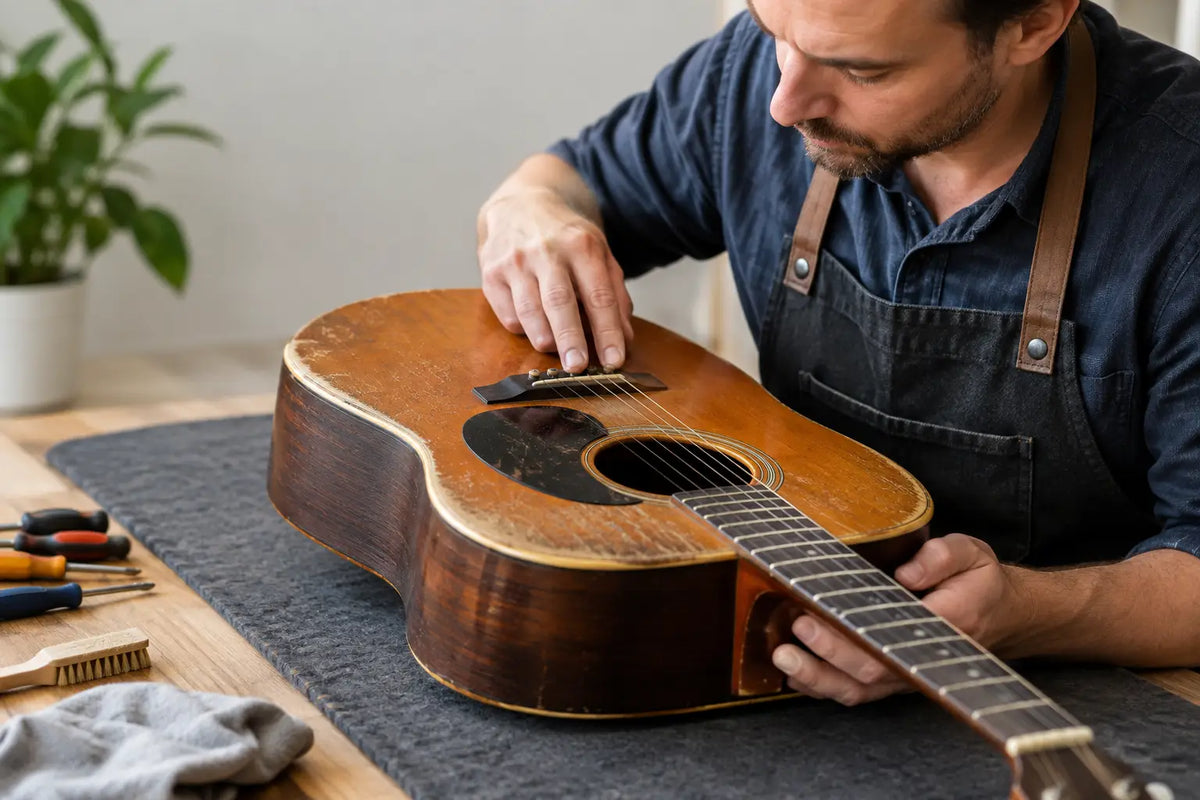
A guitar arrives with decades of dust under the strings, a lifting bridge, tarnished hardware and a case that smells faintly of somebody else's rehearsal room. It is tempting to write it off. But can old guitars be restored? Very often, yes - and sometimes the result is an instrument with more character, better playability and greater value than a shiny replacement.
The important question is not simply whether an old guitar can be repaired. It is whether the repairs make sense for the instrument, its history and the way you want to play it. A battered 1970s Japanese electric might be a brilliant workshop candidate. A budget acoustic with severe structural damage may cost more to save than it will ever be worth. Both still deserve an honest assessment.
Can old guitars be restored without losing their character?
A good restoration respects what makes the guitar worth keeping. That could mean preserving an original finish, retaining period-correct parts, or leaving a few honest marks that tell its story. Restoration is not always about making an instrument look factory fresh. For many vintage and collector-grade guitars, over-polishing, refinishing or replacing original components can remove a large part of their appeal.
For a working player's guitar, the priorities may be different. Reliable tuning, comfortable action, level frets and quiet electronics are usually more useful than a historically exact screw or a scratchy original potentiometer. The right approach depends on whether the guitar is a daily player, a family heirloom, a future trade-in, or a rare piece that needs careful conservation.
That is why an inspection comes first. A proper look over should establish the guitar's make, age, origin, modifications and overall condition before any work begins. The same cracked finish can be cosmetic on one instrument and a sign of a structural issue on another.
What can usually be repaired?
Most old guitars suffer from a manageable collection of age-related problems. Dust, corrosion, dried-out fretboards, old strings, loose output sockets and noisy controls are common and rarely serious. A clean, restring, setup and contact clean can transform an instrument that has sat untouched for years.
Fret wear is also highly repairable. Light grooves can sometimes be dressed and crowned, while heavily worn frets may call for a refret. A refret is a significant job, but on a well-made guitar with a healthy neck it can give decades more service. It is especially worthwhile on a beloved player or a quality vintage instrument where the original neck is otherwise sound.
Electronics can usually be repaired or sensitively replaced. Crackling volume pots, failed switches and weak output jacks are normal workshop jobs. Where value matters, original parts should be retained where practical, even if replacements are fitted for everyday use. Original pickups, machine heads and wiring can be important to collectors, so do not bin old components without checking what they are.
Hardware presents a similar choice. Rusted screws and dull bridge saddles often clean up well, but deeply pitted or seized pieces may need replacing. Modern replacements can improve reliability, though they may not match the original footprint or appearance. On an unusual older guitar, sourcing the correct parts can be slower and more expensive than the repair itself.
Acoustic bridges, cracks and neck resets
Acoustic guitars need a closer structural check. A lifting bridge, dry timber cracks, loose braces or a sunken top should be assessed before strings are tightened to pitch. These repairs are possible in skilled hands, but they vary hugely in cost and complexity.
A neck reset is the classic example. If an acoustic's action has become high because the neck angle has changed, simply filing down the saddle may only buy time. A reset restores the geometry properly, but it is specialist work and can be difficult to justify on a low-value instrument. On a fine older acoustic with a great voice, however, it can be exactly the repair that brings it back into regular use.
Solid-body electrics are generally more forgiving. Cosmetic chips, finish checking and buckle rash seldom affect their sound or stability. A warped neck, damaged truss rod or severe headstock break is more serious, but even these are not automatic write-offs. The quality of the repair, rather than the fact a repair exists, is what matters.
When restoration is worth the money
Value is only one part of the decision. If a guitar was your first proper instrument, belonged to a parent, or has a sound you have never found elsewhere, a repair can be worthwhile even where the numbers do not line up. Instruments carry music and memories as well as resale prices.
If resale is the aim, be more selective. Originality, maker, model, year, country of manufacture, rarity and condition all affect what a restored guitar may be worth. A sympathetic setup, structural repair and professional fretwork can make a desirable guitar easier to sell and easier to trust. A complete respray, non-original routing or a set of unsuitable replacement parts may have the opposite effect.
Japanese-made instruments from the 1960s through to the 1980s are a good example. Many were built exceptionally well, yet were once treated as affordable alternatives rather than collectable guitars. A quality Tokai, Greco, Ibanez, Yamaha or Fernandes can absolutely merit thoughtful restoration, particularly if the neck, body and original pickups are in good order. The same principle applies to older British-made, American and European instruments.
Before approving larger jobs, weigh up four things: the likely repair cost, the guitar's realistic market value, the quality of its fundamental build, and what it means to you as a player. A workshop should be comfortable explaining the trade-offs rather than pushing every instrument towards the most expensive option.
Beware the quick fix
Old guitars inspire enthusiastic home repairs, and some basic care is perfectly safe. Fresh strings, a gentle clean, appropriate fretboard conditioner and tightening an obviously loose screw can be useful. But several common shortcuts cause lasting damage.
Do not use household furniture polish on a guitar finish, especially nitrocellulose lacquer. Avoid soaking a fretboard in oil, forcing a truss rod that will not turn, or gluing a crack without understanding where and why it formed. Heat, moisture and string tension are all involved in guitar construction. A repair that looks tidy from the outside can make a later professional repair much harder.
Refinishing deserves particular caution. A poor respray can hide repairs, alter the feel of the neck and dramatically reduce collector appeal. Even a beautiful refinish is rarely the right answer for a vintage guitar unless the existing finish is beyond saving or the instrument is already far from original. Cleaning and stabilising an aged finish is often a better route than trying to erase every sign of time.
What a professional assessment should cover
A useful workshop assessment goes beyond spotting obvious damage. It should check neck relief, fret condition, action, nut height, bridge condition, truss rod movement, tuning stability and the security of the neck joint. On acoustics, it should also examine braces, top movement, bridge lift and humidity-related cracks. On electrics, pickup output, earthing, pots, switches and sockets all deserve attention.
It also helps to establish what has already been changed. A guitar with replacement tuners may be absolutely fine as a player, but extra drill holes or altered headstock faces affect how it should be valued and restored. Clear photographs before work begins are sensible, particularly on rare, signed or family-owned instruments.
At Chordplay Guitars, a workshop conversation can be as valuable as the repair itself. Bring the instrument in, explain how you intend to use it, and be honest about your budget. Sometimes the answer is a straightforward setup and restring. Sometimes it is a careful refret or structural repair. Occasionally, the fairest advice is to preserve the guitar as it is and put the money towards another player.
Give the guitar the future it deserves
An old guitar does not need to be perfect to be worth saving. It needs a sound structure, a realistic plan and repairs that suit its place in your hands. Whether it becomes a reliable gigging instrument, a striking collector piece or the guitar you finally pass on to the next player, start with a careful assessment before reaching for polish, glue or a screwdriver.
Share:
PRS SE Review - Are These Guitars Worth It?
Guitar Resale Trends UK Players Should Know