The choice often starts with one riff. Play a sharp, percussive country rhythm through a clean amp and the Telecaster feels immediately at home. Add a little drive, reach for a wide blues bend or a shimmering chord, and the Stratocaster starts making a very strong case. Fender Stratocaster versus Telecaster guitars is not really a contest between better and worse - it is a choice between two brilliantly useful designs with different strengths under the fingers.
Both are proper working guitars. They have appeared on countless records, survived decades of pub stages and studio sessions, and remain just as relevant to a first-time player as they are to a serious collector. Yet their familiar outlines can hide meaningful differences in sound, comfort, electronics and upkeep. The best choice comes down to the music you play, the feel you enjoy and how you expect the instrument to fit into your rig.
Fender Stratocaster versus Telecaster guitars: the core difference
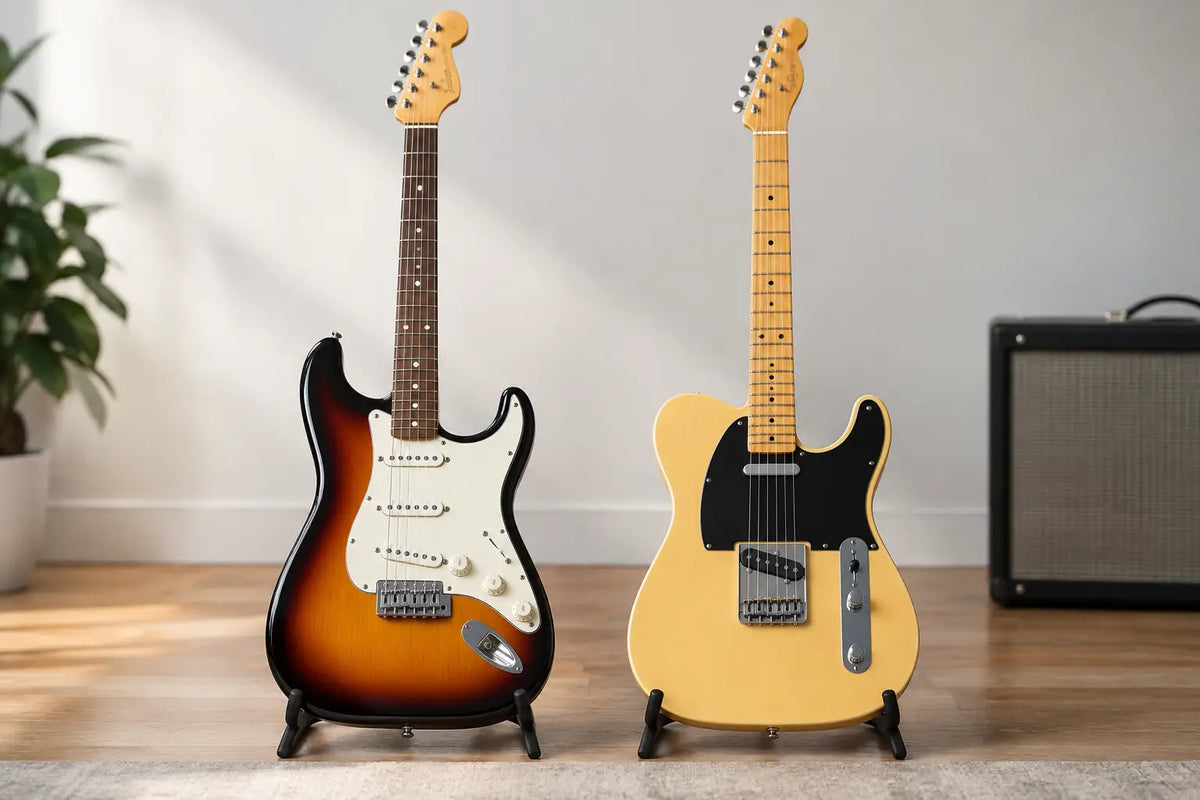
At a glance, the Stratocaster is the more sculpted, feature-rich instrument. Its double-cutaway body, three pickups and vibrato bridge make it an adaptable guitar for players who move between sounds. A traditional Telecaster is simpler: a single-cutaway slab body, two pickups, fixed bridge and famously direct control layout. That simplicity is a major part of its appeal, not a compromise.
The Strat's contoured body sits comfortably against the ribs and forearm, especially over a long rehearsal or set. Its deeper lower cutaway also gives excellent access to the highest frets. Most traditional Teles have a squared-off body edge, which feels substantial and purposeful but can be less forgiving for some players. Plenty of musicians love that solid, no-nonsense feel; others find the Strat more natural the moment they put on a strap.
Neither model has one fixed specification. Fender has produced American, Mexican, Japanese and UK-favourite special-run versions in all sorts of configurations, alongside vintage reissues and modern player-focused designs. You will find Telecasters with humbuckers, Stratocasters with hardtail bridges, different radius fingerboards and neck profiles ranging from slim modern C shapes to fuller vintage carves. Think of the classic models as the starting point, then judge the individual guitar in front of you.
Pickups and tone: bite or breadth?
A traditional Telecaster uses two single-coil pickups. The bridge pickup is mounted to, or closely associated with, the metal bridge plate, helping create the bright attack, fast response and unmistakable twang for which the model is known. It can sound lean and cutting when played clean, but turn up a valve amp and it becomes a formidable rock rhythm sound. It retains definition through overdrive better than many players expect.
The Tele neck pickup is usually warmer and rounder, though its character varies hugely by era and specification. Older-style covered neck pickups can sound smooth and slightly darker, while modern uncovered or higher-output options bring more clarity. The middle switch position blends both pickups for a sweet, balanced rhythm voice that works beautifully with light compression, spring reverb or a touch of drive.
A standard Stratocaster has three single-coil pickups and a five-way selector. Its bridge pickup provides bright lead sounds, the middle offers a neutral, glassy clean tone, and the neck pickup delivers the rounded blues and rock sound many players hear in their heads when they picture a Strat. Positions two and four combine pickups in parallel, creating the hollow, quacky sound heard across funk, pop, indie and classic blues.
That extra range makes a Strat a natural all-rounder, particularly for a player covering lots of material. Its neck pickup is generally fuller than a Tele neck pickup, while the in-between settings offer sounds a conventional two-pickup Tele cannot quite produce. On the other hand, the Tele bridge pickup has an urgency and midrange punch that often cuts through a band mix with less fuss.
Both traditional designs use single coils, so some background hum is normal around certain lights, screens and electrical sources. That is part of the vintage recipe. If silent operation or heavier gain is central to your playing, a noiseless single-coil model or an HSS Strat - with a humbucker at the bridge - may be the sensible route. There is no prize for choosing vintage-correct specifications if they fight the music you actually make.
Bridges, tuning and playing feel
The classic Stratocaster vibrato bridge is one of its defining features. It lets you add gentle chord shimmer, vocal-style bends, surf wobble and more dramatic pitch effects without reaching for a pedal. Set up well, it can be reliable and expressive. It does, however, introduce more moving parts, and tuning stability depends on sensible string fitting, a properly cut nut, healthy strings and the way the bridge has been adjusted.
Some players keep their Strat bridge floating for upward and downward movement. Others deck it against the body for a firmer feel and downward-only use. Neither approach is wrong. A floating bridge tends to make double-stop bends interact with one another, while a decked bridge can feel more stable and direct.
A Telecaster's fixed bridge is refreshingly straightforward. Change strings, tune up and get on with playing. The string-through-body design used on many models adds a taut, lively response, while the three-saddle vintage bridge contributes to the classic snap and sustain. Traditional straight saddles can require a small intonation compromise, particularly with modern string gauges, but compensated saddles solve much of this while retaining the look and feel. Six-saddle Teles offer more individual adjustment still.
For players who bend hard, use altered tunings or want a reliable grab-and-go guitar for regular gigs, the Tele's fixed bridge can be a real advantage. For those whose sound relies on movement and expression from the picking hand, the Strat's vibrato is difficult to replace. A hardtail Strat is worth considering if you love the three-pickup layout but prefer fixed-bridge simplicity.
Which guitar suits your music?
The Telecaster is often labelled a country guitar, but that description is far too narrow. It is superb for country, certainly, but its immediate attack suits punk, indie, garage rock, soul, blues and hard-edged classic rock. It takes pedals extremely well, and its uncomplicated controls encourage players to use the volume knob and picking dynamics rather than endlessly adjusting settings.
The Stratocaster has equally broad credentials. Its comfort, five pickup positions and vibrato bridge make it a strong choice for blues, funk, pop, worship, alternative rock, classic rock and session work. If you regularly need clean sparkle, smooth neck-pickup leads, tight rhythm sounds and a bridge sound for solos from one instrument, the Strat is hard to beat.
For a beginner, body comfort can matter more than genre labels. Sit down with both. Stand with both on a strap. Notice whether your picking arm meets a hard body edge or a contour, whether the controls are placed where you like them, and whether the neck shape makes you want to keep playing. A guitar that feels inviting gets picked up more often, and that matters far more than an internet verdict.
Buying new or used with confidence
With used Fender guitars, condition and originality can be every bit as significant as the model name on the headstock. A well-looked-after Japanese-made Strat or Tele can be a spectacular player, while an older American instrument may command interest for its year, finish, case candy or period-correct parts. Collector value and playing value overlap sometimes, but not always.
Check fret wear, neck relief, truss-rod function, electrics, tuning machines and signs of repairs. On a Strat, pay special attention to the bridge posts, tremolo block, springs and nut. On a Tele, inspect the saddles, bridge plate, pickup height and control plate. A few honest marks are rarely a concern on a guitar built to be played, but structural cracks, lifting frets or poorly executed modifications deserve proper assessment.
A professional setup can transform either model. Nut-slot height, fret condition, pickup balance and bridge adjustment have a huge effect on comfort and tuning. At Chordplay Guitars, the workshop perspective is part of the value of buying from people who understand what makes an instrument play properly, not merely look good in photographs.
If you are torn, do not wait for a mythical answer that makes one design universally superior. Plug both into an amp similar to your own, play the parts you actually play, and listen with the band sound in mind. The right Fender is the one that makes you forget the comparison and start another song.
Share:
Ibanez AZ Guitar Review: Is It Right for You?
PRS SE Review - Are These Guitars Worth It?