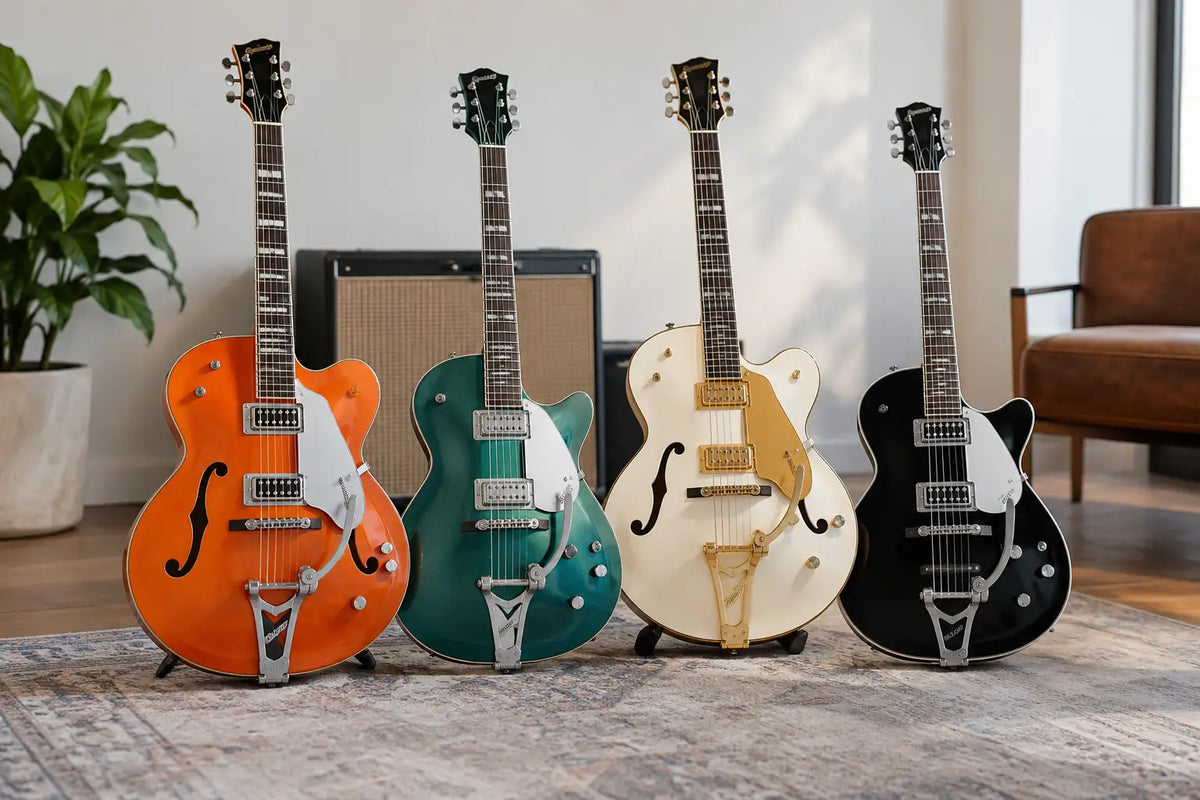
A Gretsch is rarely a guitar that disappears into a mix. Whether it is the sharp crack of a Filter'Tron, the woody air around an open chord or that unmistakable Bigsby shimmer, these instruments have a voice of their own. This Gretsch guitar review looks beyond the headstock and handsome finishes to help you work out where that voice fits - and which type of Gretsch deserves your attention.
Gretsch has made its name on character. That makes it an exciting brand to buy, but it also means choosing one is less straightforward than simply picking a body shape and colour. A Streamliner, Electromatic and professional Japanese-made model can all look classically Gretsch from across the room, yet they feel, sound and perform very differently.
What makes a Gretsch sound like a Gretsch?
The familiar Gretsch sound sits between several worlds. It has more chime and attack than many traditional humbucker guitars, more body than a typical solid-body single-coil instrument, and a tightness that keeps chords defined when an amp is pushed. It is a natural home for rock 'n' roll, rockabilly, country, blues, indie, garage and roots music, but it is not trapped in the 1950s.
A large part of that identity comes from the pickups. Filter'Trons are low-output humbuckers with a bright, focused top end, firm bass and a distinctive percussive response. They clean up beautifully and retain note separation with overdrive. Broad'Tron pickups generally offer a thicker, more contemporary humbucker flavour, while single-coil designs such as Dynasonics bring extra bite, sparkle and rawness.
Then there is construction. A fully hollow body has a lively, acoustic quality and responds brilliantly to a player’s touch. A centre-block semi-hollow guitar is more controlled at volume and has greater sustain. Solid-body models such as the Jet family trade some hollow-body bloom for punch, focus and fewer feedback concerns.
Gretsch guitar review: the main ranges explained
Streamliner - the affordable route into the look
The Streamliner range is designed for players who want Gretsch styling and a useful, capable guitar at a friendlier price. These models often feature Broad'Tron pickups and, depending on the model, a hollow or centre-block build. They are a strong option for a first serious electric guitar, a reliable second instrument or a player who needs that classic visual appeal without stepping into premium pricing.
Their sound is often warmer and fuller than the traditional Filter'Tron recipe. That is not a fault, but it is worth understanding before buying. If your reference point is the lean, jangly attack of a vintage Gretsch recording, a Streamliner may need pickup adjustment, amp settings or a pedal to get closer. If you play blues-rock, indie or general covers work, its broader humbucker voice may be exactly the flexibility you need.
Electromatic - the sweet spot for many players
For many guitarists, the Electromatic range is where the Gretsch experience becomes particularly convincing. These guitars commonly bring better hardware, more period-correct appointments and, on many models, genuine Filter'Tron-style pickups. The G5420 hollow body, G5655 centre-block models and Jet-style Electromatics all have a loyal following for good reason.
An Electromatic hollow body can deliver the glorious visual presence and responsive feel players expect from a Gretsch without the price of a professional-series instrument. The trade-off is that a large hollow guitar will not behave like a solid-body when the gain and stage volume rise. With sensible amp placement and gain settings, it is very manageable. For loud rehearsal rooms, high-gain pedals or regular gigging through a cranked valve amp, a centre-block Electromatic is often the safer choice.
The Electromatic Jet deserves special mention. It is compact, comfortable and deceptively versatile, with a chambered body that gives it a little Gretsch resonance without the size of a full hollow body. It suits players moving from a Les Paul-style guitar who want more snap and clarity, or anyone after a striking instrument that is easy to use for a full evening’s set.
Professional Collection - where the detail matters
The Professional Collection is where Gretsch’s Japanese-made instruments come into their own. These are serious working guitars and, in many cases, collector-grade pieces too. The finish work, fretwork, hardware, pickup performance and overall consistency tend to be excellent, while the specifications are usually much closer to the historic models that established the brand’s reputation.
Models such as the G6120, White Falcon and Country Gentleman are not simply expensive versions of the same idea. They have their own scale lengths, body depths, bracing, pickup choices and visual identities. A 6120 is often the archetypal rock 'n' roll Gretsch: lively, bright and wonderfully expressive. A White Falcon has huge stage presence and a broad, luxurious voice. A Country Gentleman is more refined, controlled and famously suited to articulate rhythm work.
A professional Gretsch rewards a player who notices the small things. The way a chord opens up, the response of the volume control and the feel of a well-cut nut matter here. If you have played an entry-level hollow body and loved the concept but felt it lacked refinement, this is the range that can turn appreciation into obsession.
Hollow, semi-hollow or Jet?
The right Gretsch body style depends less on what looks best in photos and more on how and where you play.
A full hollow body is the choice for players chasing maximum resonance, warmth and vintage personality. It excels at clean sounds, edge-of-breakup amp tones and rhythmic playing with plenty of dynamics. The larger body can feel substantial, particularly for smaller players, although many find that part of the appeal. Feedback is not inevitable, but it is part of the equation at louder volumes.
A centre-block model keeps much of the hollow-body look and airiness while adding stability. It is a sensible all-rounder for gigging musicians, especially those using pedals, driven amps and higher stage volume. You may lose a little of the fully hollow guitar’s acoustic bloom, but gain sustain and confidence.
A Jet is the practical choice for players who want a Gretsch sound without committing to a big-bodied instrument. It sits close to the body, travels well, handles gain happily and can cover a surprising amount of ground. For many home players and function-band guitarists, it may be the most sensible Gretsch - even if a big orange hollow body remains the dream.
Bigsby vibrato: brilliant, but not for everyone
The Bigsby is one of the most recognisable parts of the Gretsch story. Used with a light touch, it adds a gentle wobble to chords and melodic lines that no modern double-locking tremolo quite replicates. It is expressive rather than extreme.
It also asks for a properly set-up guitar. A well-cut nut, appropriate string gauge, sensible bridge setup and careful restringing make a major difference to tuning stability. Many supposed Bigsby problems are setup problems. At Chordplay Guitars, this is exactly the sort of detail a workshop check can address before an instrument becomes a source of frustration.
If you never use vibrato, do not buy a Bigsby solely because it looks right. It adds weight, changes the feel slightly and makes string changes slower. A hardtail Gretsch is often a cleaner, simpler choice, particularly for players who value quick maintenance and direct attack.
Things to check before buying
Gretsch guitars vary in scale length, nut width and neck profile, so playing one is worthwhile wherever possible. A shorter-scale model can feel slinkier and more forgiving, while a longer-scale instrument may have tighter string tension and a little more snap. Neither is automatically better.
Pay attention to the bridge too. Some vintage-style designs allow the bridge base to move slightly under string tension, which is authentic but unfamiliar if you are used to fixed hardware. Check intonation, action and whether the guitar has been set up for the string gauge you prefer. On a used or vintage example, ask about fret condition, neck angle, original electronics, modifications and whether the case is included. These details affect both playing enjoyment and future value.
A pristine Japanese-made Gretsch with its original case can be a particularly appealing long-term purchase. Equally, a well-priced used Electromatic that has had a professional setup may be the guitar that gets played every day. Condition, specification and feel should matter more than buying the most expensive badge available.
Is a Gretsch the right guitar for you?
If you want a guitar with personality, strong visual appeal and tones that cut through without becoming harsh, Gretsch is hard to beat. It rewards players who use dynamics, work the guitar’s controls and enjoy a sound with space around the notes. It may not be the first choice for modern metal, ultra-high-gain playing or anyone seeking a completely neutral instrument, although a centre-block or Jet can still handle far more gain than many people expect.
The best test is to play the model that suits your real musical life, not just your favourite album cover. Try the clean sound, your usual drive pedal and the volume you actually use. The right Gretsch should make you play a little differently - and make you want to pick it up again tomorrow.
Share:
Headstock Repair: Can Your Guitar Be Saved?
How to Restring Locking Tuners Without Fuss