
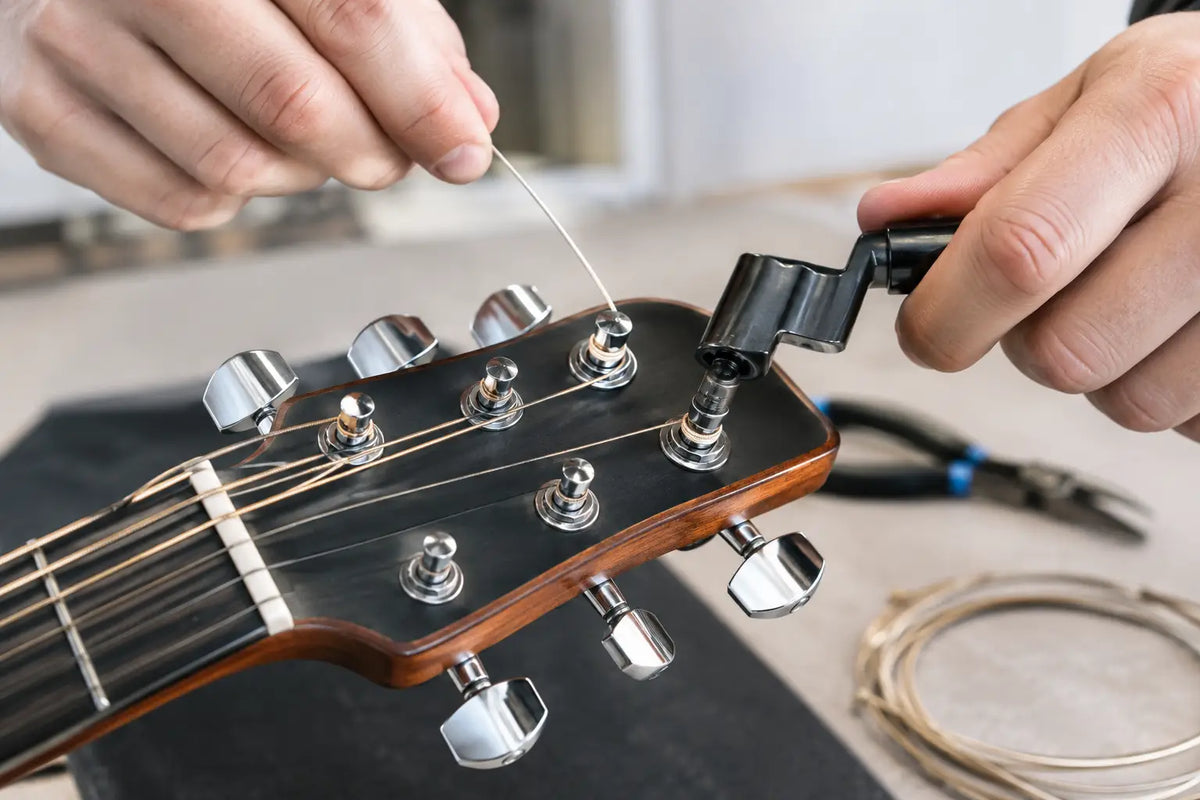
A fresh set of strings should make a guitar feel lively, not turn into a wrestling match with loose coils and sharp wire ends. Once you know how to restring locking tuners, the job is usually quicker than on standard machineheads: there is no need for three tidy wraps around each post, and much less chance of string slip. The trick is understanding what the locking mechanism does - and what it does not do.
Locking tuners grip the string inside the post with a small cam, pin or clamp. You still need to fit the correct string, bring it to pitch gradually and stretch it properly. Do that well and you can have a clean, stable restring ready for rehearsal, a gig or a proper afternoon at home.
Before you restring locking tuners
First, identify the style of tuner on your guitar. Most use a knurled thumbwheel on the back of the headstock. Turning it clockwise raises a pin inside the string post and clamps the string; turning it anti-clockwise releases it. Some modern designs lock automatically as you tune up, while a few have a small screw or wheel on the top of the post.
The basic process is the same, but do not force anything. If a wheel feels unusually stiff, stop and check whether the string is still under tension. On older or used guitars, a little grime around the mechanism can make a perfectly good tuner feel reluctant.
Have your new set of strings, wire cutters, a tuner and a soft cloth ready. A string winder can speed things up, though it is less essential here than with conventional tuners. If you are changing gauge, tuning or string type, remember that the guitar may need a setup afterwards. Moving from 9s to 11s, for example, can alter neck relief, nut behaviour and intonation.
If your guitar has a Floyd Rose or similar double-locking tremolo, there is another consideration: the locking nut at the headstock. You will need to release that before changing strings, and fitting one string at a time is often the safest way to keep the bridge balanced. Locking tuners are still useful on these guitars, but they do not replace the locking nut.
Remove the old strings carefully
There are two sensible approaches. If you are fitting the same gauge and the guitar has a floating tremolo, change one string at a time. This keeps the bridge close to its normal position and makes the final tuning less dramatic. On a fixed bridge, or when you plan to clean the fretboard thoroughly, remove all the strings together.
Slack each string until it has no meaningful tension. Then turn the locking wheel anti-clockwise to release the clamp. Pull the string back through the post and remove it from the bridge. Avoid cutting a string while it is at full pitch. Apart from the obvious risk to your hands and finish, it can give a floating bridge an abrupt and unnecessary shock.
With the strings off, wipe down the areas you cannot normally reach: the fretboard, the front of the headstock and around the bridge saddles. A dry cloth is enough for most jobs. Use products sparingly, particularly on unfinished maple boards, vintage instruments and guitars with delicate lacquer. This is also a good time to check that each tuner mounting nut and screw is snug, not overtightened.
How to restring locking tuners step by step
Start with the lowest string. Feed the ball end through the bridge exactly as the guitar is designed for it, then draw the plain end up to the tuner post. On a three-a-side headstock, make sure the string follows a sensible, straight route from nut to post. On a six-in-line Fender-style headstock, guide it through the appropriate string tree if fitted.
Turn the thumbwheel anti-clockwise until the post hole is fully open. Thread the string through the hole, then pull it through until it is almost straight but not pulled tight. Leave a small amount of slack - roughly 10 to 20 mm is plenty for most locking tuners.
That small amount matters. You do not need the usual two or three wraps, but a fraction of a turn around the post can help create a neat break angle over the nut, especially on a headstock with no string trees. Too much slack defeats the purpose and can leave an untidy coil; none at all can make the string awkward to seat and may leave insufficient downward pressure at the nut on some guitars.
Hold the string taut with one hand and tighten the locking wheel clockwise with the other. It should become firm as the internal pin traps the string. Hand-tight is enough. Do not reach for pliers, and do not crank the wheel down as though you are tightening a bridge saddle. The clamp needs to grip the string, not crush it.
Now tune slowly up to pitch. As you turn the machinehead key, the post takes up that small amount of slack and the string settles into its normal path. Once it is close to pitch, use cutters to trim the excess string from the back of the post. Leave only a few millimetres. Cut carefully and point the sharp end away from the headstock finish.
Repeat this across the set. It can be tempting to lock every string first and tune at the end, but bringing each string roughly into tension as you go makes it easier to spot an incorrectly seated ball end, a misplaced string tree or a string that has missed its nut slot.
What about staggered locking tuners?
Many modern guitars use staggered posts: the low strings sit on taller posts and the high strings on shorter ones. This increases the downward angle over the nut without string trees. Restring them exactly as above, but take particular care not to leave excessive slack on the short treble-side posts. One partial wrap is normally all that is needed.
Stretch the strings, then tune again
New strings do not truly "stretch" very much in the way players sometimes imagine. What mostly happens is that the wraps settle, the ball ends bed in and the string finds its final position at the nut and saddle. You can speed that process up gently.
Tune each string to pitch, then support it around the middle of its length and lift it lightly away from the fretboard a few times. Do not yank it hard enough to bend it into a new shape or pull it out of the nut slot. Retune and repeat until each string returns close to pitch after a gentle pull.
On guitars with a vibrato system, use the arm lightly after the first tune-up, then retune. Repeat a few times. If the pitch still wanders badly, do not assume the locking tuners have failed. The usual culprits are a binding nut slot, poorly seated strings, a floating bridge that needs balancing, or simply a fresh set that has not settled yet.
Common locking tuner mistakes
The most common mistake is fitting too much string before locking it. The whole point is to minimise wraps, so pull the string nearly tight before clamping. The opposite mistake is locking a completely tension-free string without allowing for break angle. A little slack gives you a clean result.
Another is tightening the locking wheel far beyond hand pressure. This can mark the string, make removal difficult and, in extreme cases, damage the mechanism. A quality locking tuner should hold pitch with a firm finger-tight clamp.
Also resist the urge to blame tuning problems on the tuners immediately. A tuner only holds the string at the headstock. If a string catches in the nut, if a bridge saddle has a burr, or if the guitar’s setup is out after a gauge change, locking the post will not cure it. This is especially relevant on older, vintage and well-loved instruments, where the nut and frets may need as much attention as the hardware.
When a restring needs more than fresh strings
A clean restring is a good chance to listen to what your guitar is telling you. Buzzing that was not there before, a nut slot that pings during tuning, sharp fret ends or intonation that will not settle are all worth investigating. For a player who changes strings regularly, a professional check-over can prevent small issues becoming expensive ones.
If the locking wheel will not release, a tuner post wobbles, or the string keeps slipping despite correct fitting, stop forcing it. Chordplay Guitars' workshop can assess the hardware and setup, whether it is a dependable gigging guitar or a rare instrument you would rather not risk at home.
Once the final tune holds, play the guitar for ten minutes before judging the job. Work through some bends, chords and any tremolo use you normally rely on. A properly restrung set of locking tuners should feel pleasingly uneventful - clean headstock, minimal wraps and a guitar that stays ready when you pick it up tomorrow.
Share:
Gretsch Guitar Review: Which One Suits You?
Refret Before and After Results Explained